Enough Is Enough
UltraReach and a practical push for safer pole work
By Sophie Vale | Look Up Look Out | 4 October 2026
Two insulated lower sections are now the headline feature of UltraReach’s “Enough Is Enough” campaign. It is a practical change aimed at a real weakness in how long poles are handled. The useful question is not whether insulation makes overhead work safe. It does not. The question is whether a larger insulated handling section, backed by visible test evidence and clear warnings, is a sensible extra safeguard. Our review says yes, within the evidence we assessed.
Adam Carroll says the campaign grew from concern about long-reach equipment being used near overhead power lines. His aim is to get cleaners, operators and manufacturers to take the risk more seriously. That matters: the industry has spent years talking about reach, stiffness and weight, while the wires above the job can be rather less forgiving than a product brochure.
Look Up Look Out has reviewed evidence relating to named UltraReach configurations and records the relevant recognition on its comparison pages. We are clear about that connection. This feature is an editorial review by the campaign, not a claim that the campaign has certified the product or every item in the range.
What changed on the pole
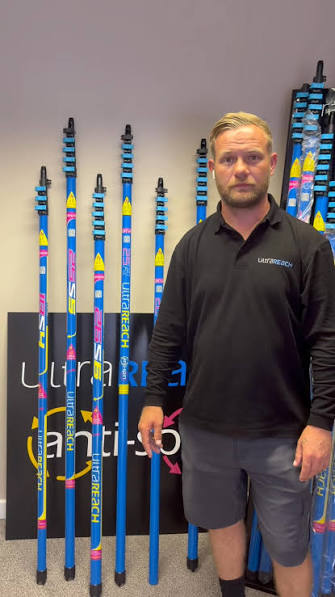
UltraReach now advertises two insulated lower sections as standard across its water-fed pole range. The range pages cover Type R, UltraLight and Type S families, from short domestic poles to long professional builds. The separate gutter-vac range also describes two fibreglass lower sections. These are the manufacturer’s current published specifications; we have not physically inspected every pole or every production batch.
The practical logic is easy to follow. Hands move while an operator extends, adjusts, angles or steadies a telescopic pole. With one insulated lower section, a hand can end up above that section during ordinary handling. A second insulated section gives the operator more insulated pole length to work with before reaching the conductive carbon-fibre sections. The amount of usable insulated length depends on the model and how the telescopic sections overlap, so we are not putting a neat-sounding percentage on it without model-by-model measurements.
Adam says UltraReach considered Kevlar and chose fibreglass for its application after weighing stiffness, wear, fraying, ultraviolet exposure and chemical contact. Those are his reasons for the design choice, not a universal verdict that one material is always better. The point for a buyer is simpler: ask what each section is made from, what is actually insulated, and what evidence applies to the exact model you are buying.
The pole itself: what is on offer
The choice is broader than a single “UltraReach pole”. The current water-fed range is grouped into Type R anti-spin poles, compact Type R builds, UltraLight HiMod anti-spin models, UltraLight S and Type S non-anti-spin poles. The advertised options run from short domestic lengths to long professional poles; the category page lists models from 10ft to 54ft. Pole length and working reach are not the same figure, so the model page’s reach, section count, collapsed length and weight are the useful details to compare.
Anti-Spin is a feature of the named subfamilies, not every pole in the catalogue. On those models, the clamps are designed to stop telescopic sections rotating against one another as the pole is extended and adjusted. The range also offers different section counts and materials. That gives buyers options for reach, weight and handling, rather than one specification pretending to suit every job.
A current five-section 22ft Type R listing is a handy example of the product information now available: UltraReach gives an approximate 27ft working reach, a 157.5cm collapsed length, a 670cm extended length and an approximate weight of 1,460g. Those are the manufacturer’s published figures for that model, not measurements we took ourselves. The at-a-glance format makes them much easier to compare before buying.
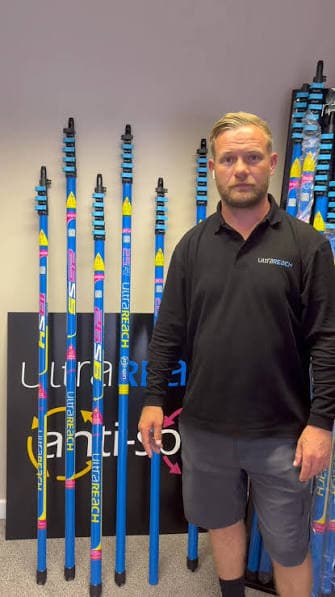
John Knight from look up look out handled an UltraReach pole at a trade show and found it stiff, well balanced, practical to use and lightweight. He also noted that it was insulated on 2 sections. That is a useful first-hand impression of the pole in the hand, and it fits the design brief: a long pole needs to feel manageable as well as reach the glass. It was a show-floor handling impression, not a full cleaning trial or a long-term test, so we are not dressing it up as a durability result.
There is a little public user feedback too. In a Window Cleaning Forums discussion, one contributor who said they used an UltraReach every day praised its light feel and anti-spin clamps, adding that the feature suited someone with back problems. That is one person’s experience, not a representative survey or a review of every current insulated model. It is still a useful real-world note: weight and clamp behaviour matter to the person holding the pole all day.
Our view is that the product proposition is appealing: a choice of lengths and builds, anti-spin options, practical dimensions published for individual models, and two insulated lower sections on the current range. John’s impression of stiffness, balance and weight adds something the specification table cannot. A hands-on cleaning trial over a working day would tell us more about fatigue, brush control and long-term wear; until then, we can praise the design and published information without pretending we have tested what we have not.
And the gutter-vac poles
There is a separate gutter-vac range as well: clamped 51mm kits in five advertised lengths from 20ft to 40ft, built from 152cm sections. UltraReach describes the lower two sections as fibreglass, with carbon-fibre sections above. The kits are offered with different 135-degree neck options, and individual sections and necks can be bought as spares. That modular approach is useful for transport and repair: a damaged section need not mean replacing the whole kit.
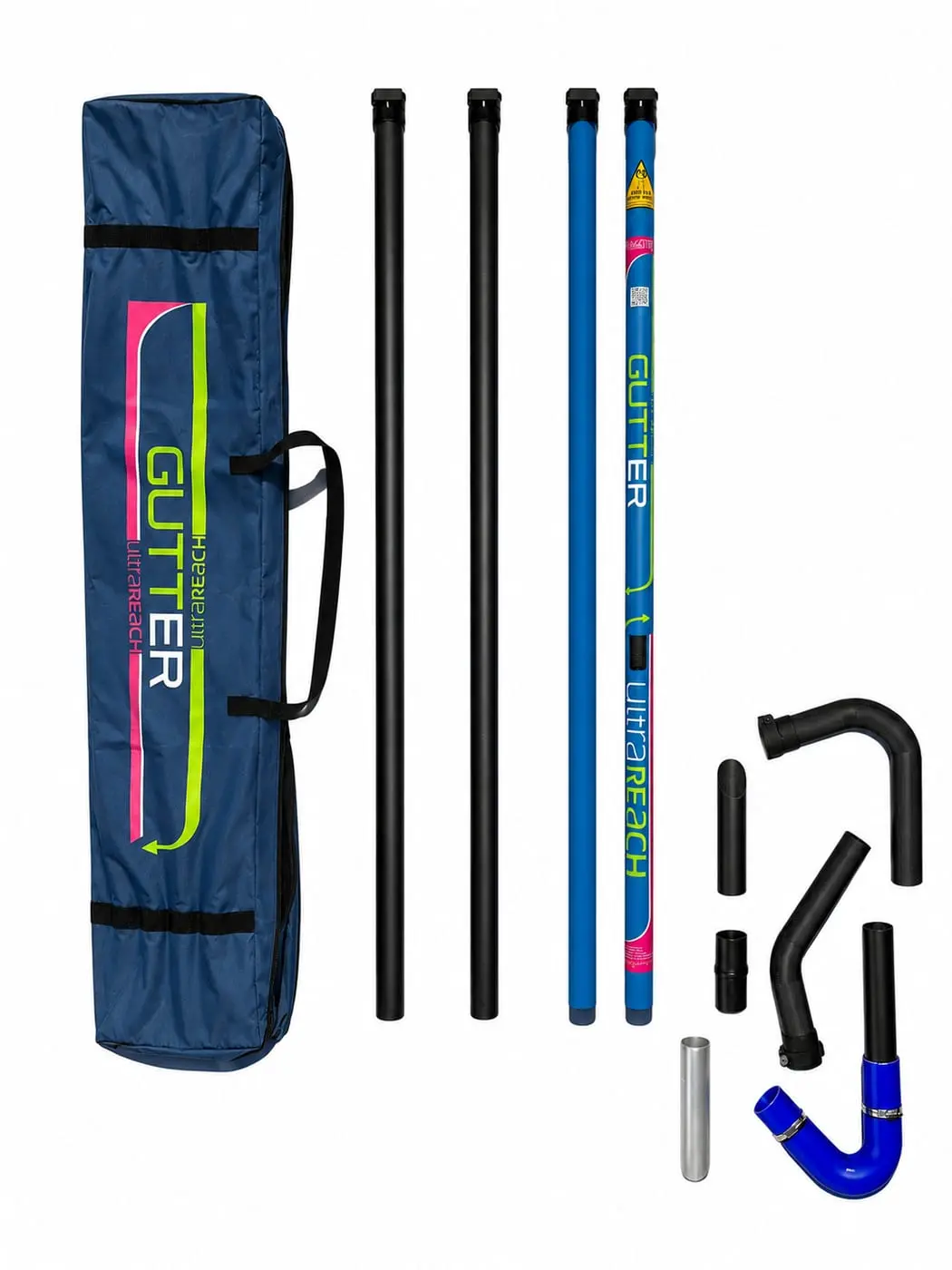
The manufacturer says the gutter-vac range is tested and certified to 80kV. Look Up Look Out’s evidence-based recognition is specifically for the named D50 four-section configuration, so we keep that distinction clear rather than imply every length has its own separate recognition. We have not handled or trialled these gutter-vac kits ourselves; this is a review of the published range and evidence.
What the reports say
The manufacturer’s safety page identifies CEMT reports 2026090278 and 2026090279, both dated 18 September 2026.
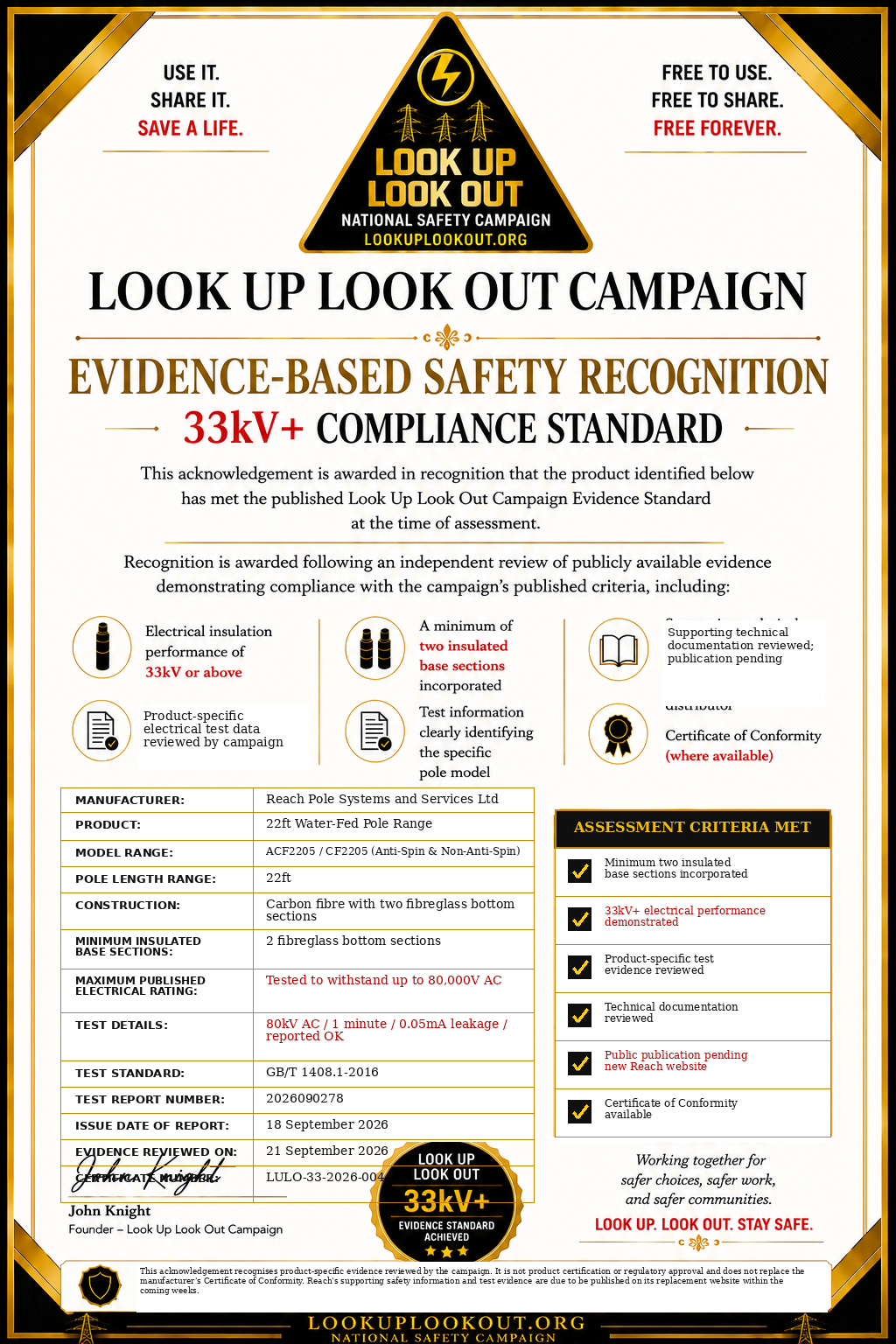
The published summary reports a full-extension test at 80 kV for one minute, with a recorded leakage current of 0.05 mA and a PASS result. The named evidence relates to the UltraSafe water-fed configuration and the D50 four-section gutter-vac configuration. The reports were reviewed by Look Up Look Out for the configurations covered by our recognition.
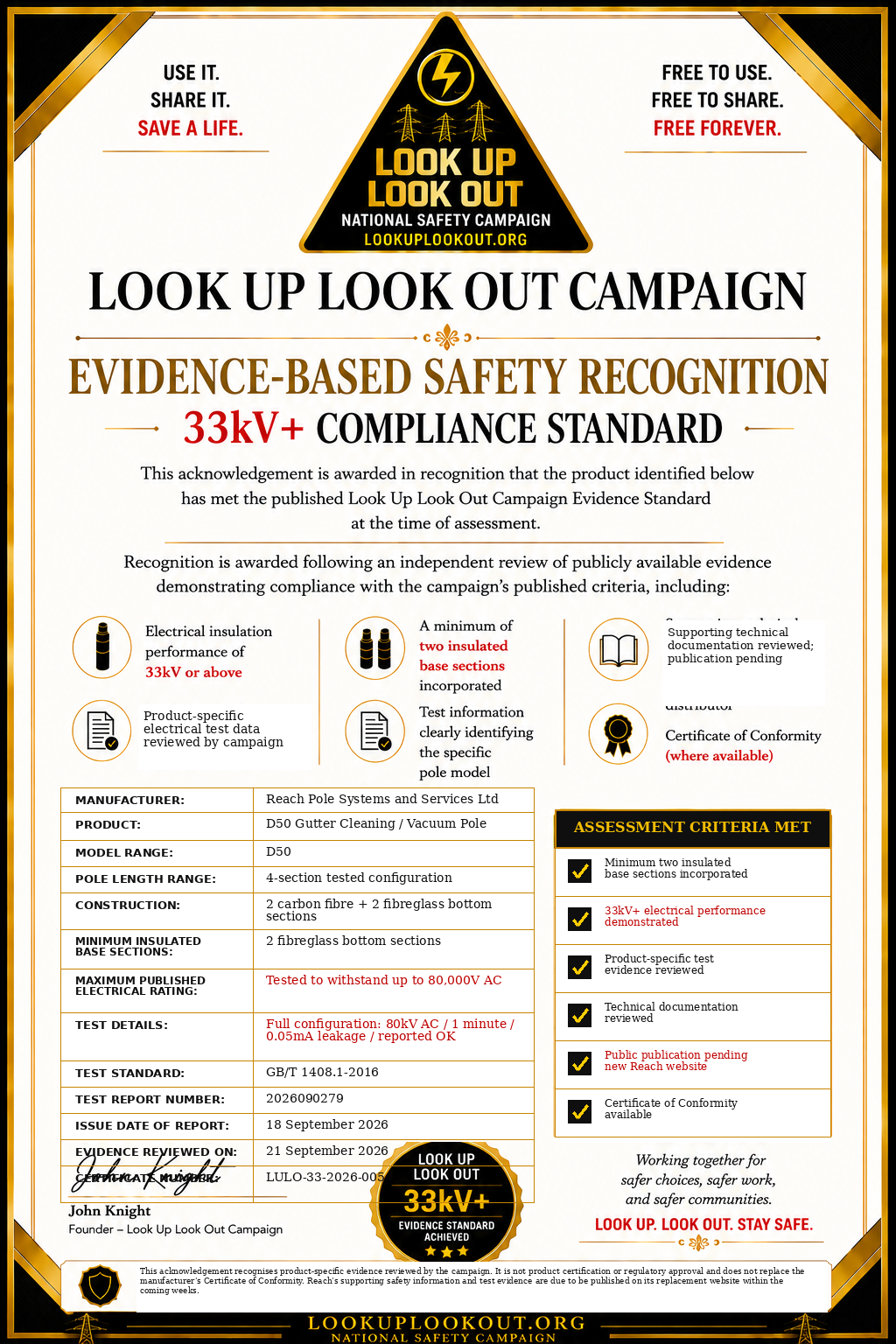
Adam says the same kV data applies across the tested UltraReach construction and range. That is useful manufacturer information, but it should not be stretched into a claim that every length, variant or configuration has separately been tested or individually recognised. The public recognition remains tied to the identified configurations. Buyers should match the report and product specification to the exact pole, rather than treat “same range” as a magic phrase that makes model details disappear.
The 80 kV result is a substantial published test result. It is not a measure of how close someone may safely work to a live line, nor does it show that one pole is “60 per cent safer” than another because its test voltage is higher. A laboratory result belongs to its method, sample and conditions. Real sites add moisture, contamination, damage, handling and the possibility of an arc. Voltage figures are useful evidence; they are not a force field. Shame, really. The force-field aisle remains empty.
The company’s page also warns about wet or contaminated surfaces and says the insulating sections must be fully extended. Adam advises checking poles before use and taking equipment out of service if it is cracked, excessively worn, damaged or contaminated. That is the right tone: insulation is a last line of defence if other controls fail, not permission to work near overhead electricity.
A better website with a few loose ends
The new UltraReach website is a noticeable improvement in how the safety story is presented. The dedicated Look Up Look Out page brings the campaign message into view, and at least one current pole page has an “At a glance” summary with reach, collapsed and extended lengths, weight and the two-section test claim. The safety page names the reports rather than leaving the customer to decode a vague “tested” badge. Those are useful steps towards information a buyer can actually check.
There is still a housekeeping job. An older 22R listing on Shop.app describes a previous specification, including one insulated lower section and a 10 kV test claim, while the current UltraReach product page describes two sections and 80 kV. That may be an old-generation listing, but a buyer should not have to play detective between pages. We recommend the retailer label older stock clearly and that customers confirm the precise model and specification before ordering.
We also want the safety message to stay consistent wherever the product appears. One page can explain the limits of insulation beautifully; a stale listing or loose phrase elsewhere can undo that work in a hurry. Clear model names, report references and matching product summaries should travel together.
The campaign and the people using the poles
UltraReach has put Look Up Look Out material and a link to our campaign on its safety page. Adam’s central phrase, “LOOK UP – BUT ALSO LOOK DOWN,” captures the point well: overhead lines are the obvious hazard, but the ground, route, setup and movements of the pole matter too. We welcome manufacturers putting practical safety advice where customers will see it.
Public cleaner feedback we could access is positive in places about value and weight, but it is anecdotal and largely predates this latest two-section range. It is not enough to judge long-term durability or speak for the whole trade. We did not carry out a hands-on cleaning trial, so this review does not score brush performance, water flow, balance or service life.
Adam says UltraReach is developing another pole material, but gave no specifications or release date. We’ll be interested when there is something concrete to assess. Until then, it stays in the “watch this space” bucket, which is where unlaunched materials belong.
Sophie’s score
★★★★★ 5 out of 5 for the electrical evidence package on the configurations recognised by Look Up Look Out.
The score reflects two insulated lower sections, named test reports, published test details and visible safety guidance for the configurations assessed. UltraSafe holds a joint-first position in our current water-fed comparison following review of report 2026090278. The score and recognition do not certify the whole UltraReach range, guarantee safety, or replace the manufacturer’s conformity documents. They are dated assessments of the evidence we reviewed.
The larger handling area is a meaningful design improvement. The test information is specific enough to be useful. The website is clearer than before, even if old listings need tidying. And the company’s own message is the one every operator should remember: keep your distance, plan the job, assess the risk and never rely on insulation to make a dangerous position acceptable.
That is what “Enough Is Enough” gets right. Two insulated sections are a worthwhile safeguard. They are not a licence to reach for the sky.
Useful links
UltraReach safety page: ultrareachsystems.com/look-up-look-out
UltraReach 22R product page: 22R Anti-Spin five-section pole
Look Up Look Out water-fed pole comparison: lookuplookout.org
Window Cleaning Forums, Ultra reach poles discussion: windowcleaningforums.co.uk/threads/ultra-reach-poles.39696/